
1. Impossible box
Big cardboard box with a heavy weight taped securely into one corner. Carry it across the room, struggling theatrically, and put it down on a table, with just the weighted corner resting on the tabletop. Let go and watch the surprised faces!

KS1/2: what’s in the box?
KS3/4: let’s talk about centre of gravity…
KS5: If I tell you the mass of the weight, can you tell me the mass of the box? Here’s a ruler….
2. Newton’s cradle
Worth buying the best one your budget will stretch to – the balls are aligned better. A £5 executive toy will disappoint.

KS1/2: why do the balls move?
KS3: let’s talk about kinetic energy stores and pathways, forces, momentum, inertia even?
KS5: reckon you’ve seen this before? Ok, how is the force actually transmitted?
3. Flying teabag
Take a wrapped teabag – the type with a string attached. Snip off the top where the string is, empty the tealeaves and you have a cylinder of lightweight teabag paper. Stand it upright (quite exciting if you stand it on a £50 note…) and set the top alight. It burns down (the owner of the £50 breaks sweat) and just before the bottom the whole thing – well, the remaining ash – takes off. YouTube film here. Whoa!
KS1/2: why do hot things rise?
KS3/4: other examples of convection?
KS4/5: would this experiment work in zero g?
4. Ferrofluid
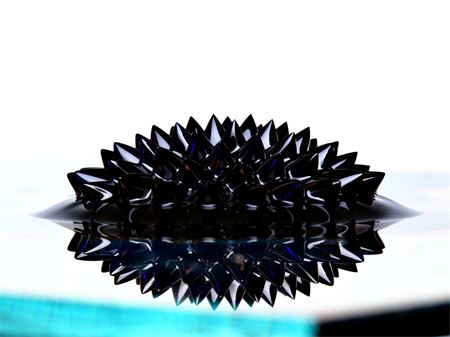
Mind your clothes – it stains! Buy some here. Pour some into a petri dish and seal the lid on. Pass it around – what is this stuff? Then get a neodymium magnet out. Wow!
KS2: what are the properties of this material?
KS3: how could we measure the size of this force?
KS5: can we use this to indicate magnetic field patterns instead of iron filings?
5. Rubber Band & Paperclip
My favourite – thank you Keith Gibbs! Thread a paperclip onto a single length of rubber band. Stretch the band and hold a few cm of slack rubber band in your right hand. Gradually let it slip through your right fingers, whilst keeping your hands the same distance apart. The paperclip moves with the band. You can stop it, start it, make it move ‘uphill’. I’ve entertained many with this one. Usual reaction = “uh?”
KS1-5 – let them have a go! Get them asking questions. Ask them about friction. I leave it up to you whether you give the secret of this one away!

Let us know if you want us to come into your school to demonstrate any of these, or talk to your team about the physics behind them.
Legal info