
Earlier this month I was invited to speak at a conference of Nordic international schools who meet regularly for information exchange and professional development.
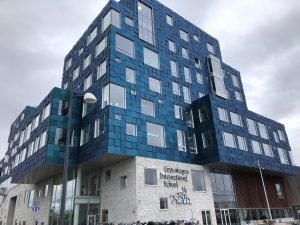 It was refreshing to learn from others at this conference and to have an opportunity to share my ideas about science education, particularly through the workshops I led on teaching numeracy skills in science, and on Young Scientists Journal. Meeting teachers and educational leaders from across the Nordic and Baltic countries was very enriching; it’s always great to meet others keen to develop their professional practice. And the innovative Copenhagen International School in its quayside location, sporting 12,000 stunning solar tiles, is an inspirational setting. Apart from the official business of the conference, I have to say that the highlights for me were travelling to the venue on an electric scooter, and being treated to dinner and dancing in the rooftop greenhouse!
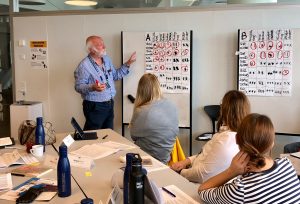 Recently, schools have been asking me to help them embed “mastery” techniques in their science teaching. To me, mastery is the embodiment of good teaching and requires methods which encourage deep learning. This sounds simple, but with pressures in the classroom it can be a challenge to change teaching styles. Geoff Petty‘s workshops here on evidence-based teaching have reinforced my belief that cognitive science has much to say about what works well and why.
We hear a lot about maths mastery and methods employed from Shanghai and Singapore, and gradually some of these ideas are transferring to science teaching. Together with cognitive science research, I reckon these ideas could transform science curricula and teaching practice. These are the essential ingredients for “mastery” teaching in secondary science as I see them, but I’d be interested to hear from others:
Recently, schools have been asking me to help them embed “mastery” techniques in their science teaching. To me, mastery is the embodiment of good teaching and requires methods which encourage deep learning. This sounds simple, but with pressures in the classroom it can be a challenge to change teaching styles. Geoff Petty‘s workshops here on evidence-based teaching have reinforced my belief that cognitive science has much to say about what works well and why.
We hear a lot about maths mastery and methods employed from Shanghai and Singapore, and gradually some of these ideas are transferring to science teaching. Together with cognitive science research, I reckon these ideas could transform science curricula and teaching practice. These are the essential ingredients for “mastery” teaching in secondary science as I see them, but I’d be interested to hear from others:

It was refreshing to learn from others at this conference and to have an opportunity to share my ideas about science education, particularly through the workshops I led on teaching numeracy skills in science, and on Young Scientists Journal. Meeting teachers and educational leaders from across the Nordic and Baltic countries was very enriching; it’s always great to meet others keen to develop their professional practice. And the innovative Copenhagen International School in its quayside location, sporting 12,000 stunning solar tiles, is an inspirational setting. Apart from the official business of the conference, I have to say that the highlights for me were travelling to the venue on an electric scooter, and being treated to dinner and dancing in the rooftop greenhouse!
Recently, schools have been asking me to help them embed “mastery” techniques in their science teaching. To me, mastery is the embodiment of good teaching and requires methods which encourage deep learning. This sounds simple, but with pressures in the classroom it can be a challenge to change teaching styles. Geoff Petty‘s workshops here on evidence-based teaching have reinforced my belief that cognitive science has much to say about what works well and why.
We hear a lot about maths mastery and methods employed from Shanghai and Singapore, and gradually some of these ideas are transferring to science teaching. Together with cognitive science research, I reckon these ideas could transform science curricula and teaching practice. These are the essential ingredients for “mastery” teaching in secondary science as I see them, but I’d be interested to hear from others:
- Build a positive learning environment where learners feel safe to have a go or make mistakes
- Encourage hard thinking through high expectations
- Use co-constructivist teaching techniques where new knowledge is embedded with existing understanding
- Introduce Big Ideas, making links between topics
- Check & correct to pick up misunderstandings, and feed these back into our teaching
Legal info