
This blog post is taken from a talk I gave at the Royal Society on 6th March 2015 at an event celebrating 350 years of scientific journals, starting in 1665 with the publication of Philosophical Transactions, which is still published today. As part of Publishing 350, the Royal Society has partnered with Young Scientists Journal to publish articles produced by schools in receipt of its Partnership Grants. This special collaborative issue is due in early July.
It was a fantastic opportunity, if somewhat daunting, to be speaking at the prestigious Royal Society in front of a host of FRS’s. I’m happy to say that many of those present were very complimentary about the journal and its aims.
 What d
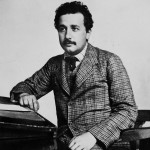 oes an early career researcher look like? To most of us, it’s perhaps a lab-coated woman or man in their early 30s. To me, as founder and mentor of YSJ, an early career researcher is still at school, studying GCSEs, A levels or an AP program or IB diploma, oozing ingenuity, sparking off her peers (and a dedicated teacher perhaps), uninhibited by the professional caution of a university researcher, nor panicked by the next funding round or research assessment. I sometimes ask students to describe Einstein, and of course they picture the old man with white frizzy hair, not the young man of 26 as he was when he published those 3 seminal papers. A teenage scientist may not know as much science as a post-grad, but they do know how to follow the scientific method and are still in touch with the breadth of the whole STEM (or STEAM) curriculum.
It surprises many that it is even possible to do original research whilst still at school. But WE know it’s possible because we publish it – all our authors (and peer reviewers, by the way) are aged 12-20. The Royal Society knows it’s possible too, which is why it initiated the Partnership Grants scheme.
Royal Society Partnership Grants
Under that scheme, since 2000, £1.3m has been channelled into 770 schools, both primary and secondary, linked with a scientist to carry out research. All benefit – teachers, pupils and the scientists – the case studies on the RS website are inspiring. So, the students running the journal and I were delighted when the Education Outreach Team suggested we join forces to celebrate Publishing 350, and get some of this fabulous work published, for all the good reasons that we should publish. So we’re collaborating on a special issue of YSJ (no 17) which is dedicated to research written by students about their Partnership Grant projects.
Young Scientists Journal
If I may I’d like to tell you a bit more about the journal if you haven’t come across us before. YSJ germinated from a seed of an idea with my co-founder Professor Ghazwan Butrous in 2006 when I was Head of Science at The King’s School, Canterbury. It offers school-age students a unique and REAL experience of writing, editing and running a science journal, enhancing their communication skills and preparing them as professionals in this information-producing age. It also fills a gaping hole by providing a vehicle for publishing very early research. So 8 years (we look forward to our 10th birthday!) , 16 issues and over 200 authors later our free online journal attracts articles from schools across the globe, with maybe a dozen submitted every month – nearly half from girls (Caroline Herschel would have been proud!). We’ve had submissions from Alaska, Mexico, Japan, India, US, even one enquiry last week from a Syrian refugee camp in Lebanon. Articles get thousands of hits – one maths paper we published in 2009 by a girl at school in Birmingham about tessellations in architecture has had over 50,000 hits and hundreds of citations!
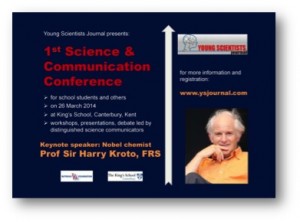 An adult Advisory Board of about 30 scientists and educators is there for expert reviewing and other support (if you’re interested in getting involved get in touch!). We held our first conference (as all self-respecting science journals should) in March 2014 with Fellow Sir Harry Kroto as keynote speaker. I’m hoping to recruit his follow-up act for our autumn conference this evening! Many articles begin life as pieces written for competitions (e.g. Big Bang, ISEF), coursework, CREST awards, Extended Essays, summer work placements – and now the fruits of the Royal Society Partnership Grants. The journal operates on virtually no budget and suffers a rapid ‘staff’ turnover – worth the challenge, I hope you agree!
Royal Society & Young Scientists Journal collaboration
The articles in our special issue cover all STEM areas, from plasma physics and crash investigations to horse chestnut disease, artificial dyes and brain wave patterns. We will be publishing work done by primary and secondary, state and independent schools. The articles are currently in review before being submitted to a panel of judges to select the best 3 who will present their papers at the Summer Exhibition on 3rd July. This will coincide with the publication of the print and online editions, which will feature all of the articles (about 16). Huge thanks to Marie-Claude Dupuis, Clare Harvey, Stefan Janucz and Steven Simpson from the RS for their work on the collaboration, as well as all the student editors involved. Of course we hope that the stream of articles from Partnership Grant schools will continue beyond this year.
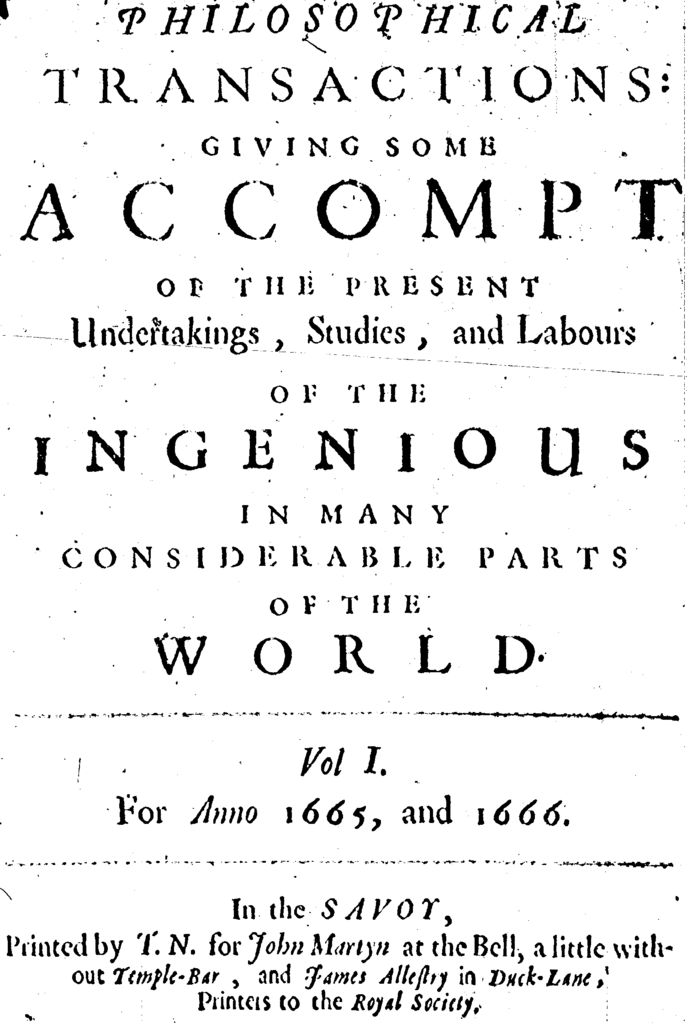
Philosophical Transactions Vol 1
Don’t underestimate young scientists!
I think that YSJ (not the world’s first scientific journal, but the first of its kind) could also be described as “Giving some account of the present undertakings, studies and labours of the ingenious in many considerable parts of the world.” Let’s not underestimate our young scientists – they are the Phil Trans authors and Royal Society Fellows of the future.
It’s about time that Headteachers and curriculum tsars woke up not only to the importance of practical work but to the real potential for original research in schools for lifting aspirations and developing vital, transferable skills.
I have certainly been humbled by the ingenuity and dedication of the students involved.
Thank you for listening.
Legal info