
This is a summary of my keynote speech at the Nuffield Research Placements Celebration Evening at BAe Systems, Rochester, hosted by MEBP on 16 October 2014. I was invited to speak as founder of Young Scientists Journal and was delighted to address the students, their parents, teachers and the placement providers about the importance of science communication.
The Importance of Writing
Have you ever wondered where we would be if writing had never been invented?
Animals can communicate: bees do their wiggle dance, dolphins click, cuttlefish can hold a conversation with up to 4 others with coloured patterns on their bodies, chimps can even string sentences together.
And humans, with our big brains, invented fire and wheels before we started writing – these were the beginnings of science, perhaps.
Cave paintings have been discovered from 30,000 years ago; pictograms featured from about 9,000 years ago – these were used for counting property. 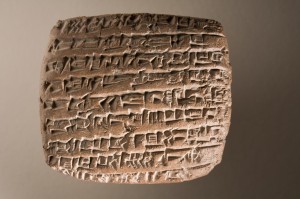 These gradually evolved into writing, via cuneiform in Mesopotamia.
Writing elevated us. We were able to record information and transfer it across generations and continents.
Now there are 1.8 million scientific papers published annually, in 28,000 journals.
Newton famously said that if he had seen further than most it was by “standing on the shoulders of giants”, building on predecessors’ knowledge. Uncharacteristically modest of him. He was of course also a bit of a genius. So science progresses at a somewhat unsteady rate – a heady mix of learning from one’s elders and leaps of genius from young rebels.
Albert and Malala
Close your eyes and picture Einstein. Ageing mad scientist look, wiry grey hair and moustache? WRONG!

Einstein’s annus mirabilis which saw the publication of FOUR key papers (the photo-electric effect, Brownian motion, special relativity and E=mc2) was in 1905 when he was just 26. In fact, with the exception of Malala Yousafzai, the 15-year-old winner of the 2014 Peace Prize, the five youngest Nobel laureates have all been physicists aged 25-31.
I read recently that the average age of Nobel prize-winners is increasing. Is that because you need to know so much more now before you can discover anything new?
Science has exploded! 90% of all scientists who ever lived are alive today. And that has held true for the last 300 years.
As we get older, sure, we know more stuff. But at the same time, our creativity (and courage?) diminishes. Also, we get more self-conscious, and professional caution can get in the way of being radically inventive. We need to catch great thinkers at a young age if we want paradigm shifts.
So, perhaps the optimum age for innovative thinking is less than thirty…?
So, publish!
You’ve just completed a piece of research on your Nuffield placement – possibly your first? Congratulations! What was the hardest part?
- learning a new skill, perhaps a computer program or language?
- persistence, coping with the boredom of repetition
- figuring out how to work the coffee machine?
- …or writing the report for tonight’s celebration?
OK, well you’ve done that now. What next? Will your report gather dust in a corner of your bedroom, or on a USB stick?
Be bold – PUBLISH!
You may not think you’ve discovered anything new, but you never know, the history of science has many examples of data that puzzled scientists but after publication others picked it up and found patterns in it – the missing final piece of their jigsaw.
And then you have to think about where to publish. Nature – unlikely. Your own blog – hmm, will anyone read it? Is there something in between which will publish articles by school students?
Young Scientists Journal
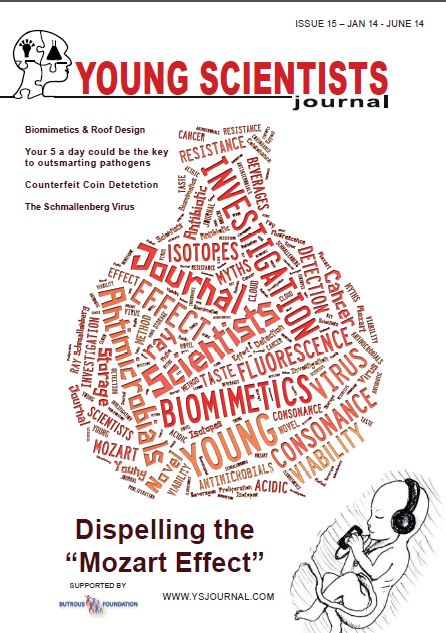
Some of you have heard of Young Scientists Journal, the online science journal written and edited by students aged 12 to 20. Being online it has a global reach, with both authors and editors coming from all over the world.
My co-founder Ghazwan Butrous and I had two aims in launching it:
- to enrich the communication skills of young scientists
- to provide a vehicle for publishing science research carried out by young scientists
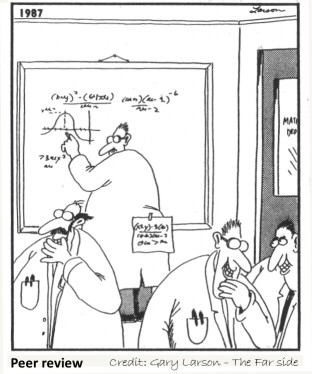
The editorial team peer review and publish articles on all science subjects on an ongoing basis and bring out two issues per year (Issue 15 was the most recent). About 40% of the articles submitted now are original research – yes, original! Many of the articles were probably written for another purpose initially: coursework, science fair, competition, or even….Nuffield research placement!
Young Scientists Journal has accreditation with CREST and the Duke of Edinburgh’s Award Scheme. We have partnered with the Royal Society in their celebration of 350 years of science publishing in 2015. Many of our editors have gone on to university and founded or worked on journals there (of course, being a published author is rather impressive on a UCAS form).
And finally…
You have done something amazing.
Now, take this final step forward from the chimps, cave paintings and cuneiform.
And join the ranks of PUBLISHED SCIENTISTS!
Thank you.
Legal info